From What People Do to What Brands Say
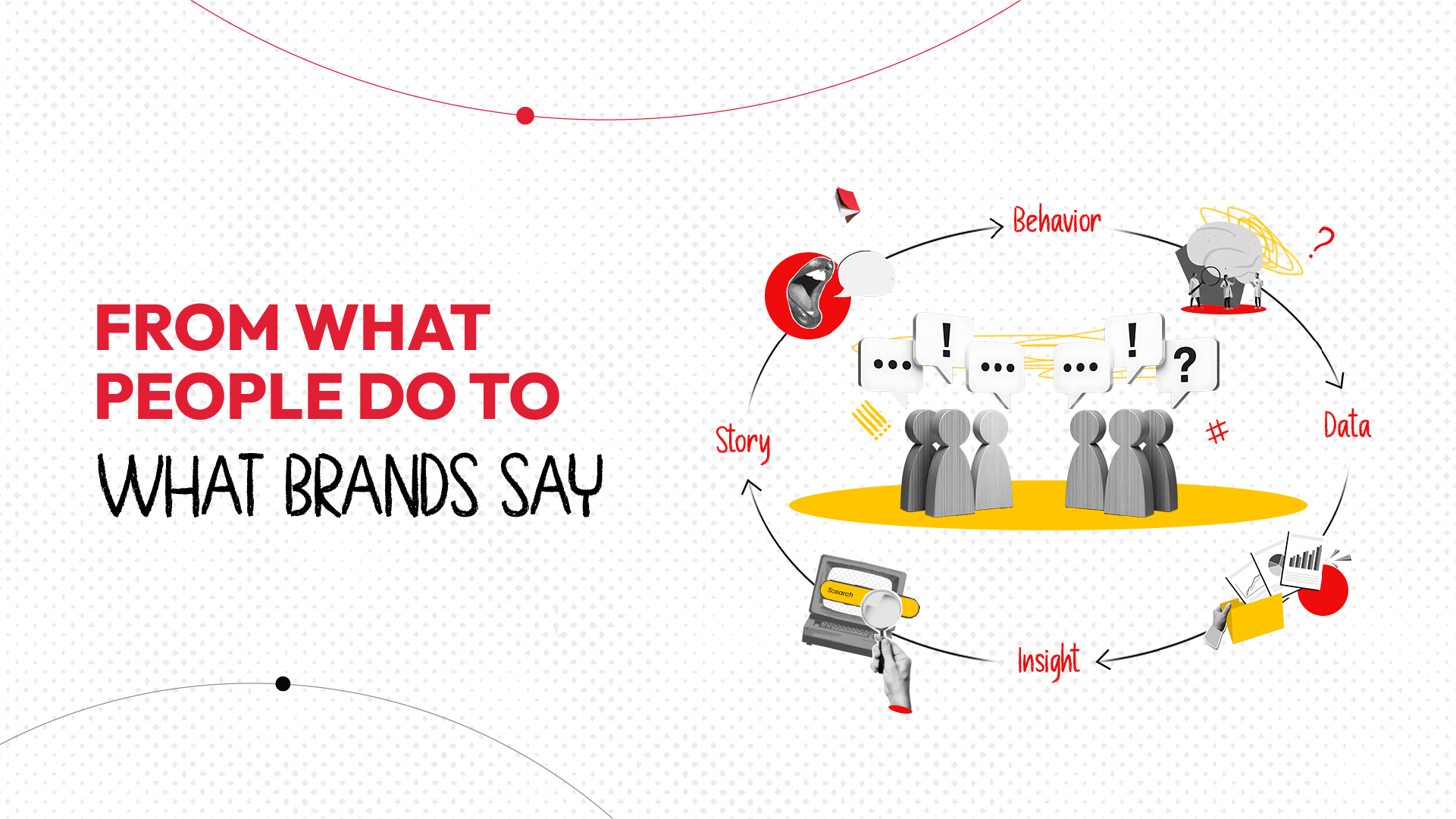
Modern advertising does not wake up each morning and choose between data and people. It runs on both.
In practice, it moves in a loop: behavior becomes data, data becomes insight, insight becomes story, and story goes back into the market to shape new behavior.
It sounds neat when written like that. In reality, it is messier, more interpretive, and far more human than most dashboards suggest.
Why Does Advertising Rely on Data?
Because scale is unforgiving.
When a brand is speaking to millions of people across platforms, regions, and contexts, there is no practical way to understand everyone in full detail. What becomes visible instead are patterns:
- Search behavior
- Purchase frequency
- Engagement rates
- Drop-off points
- Regional differences
These patterns are compressed traces of behavior. They are not biographies. They are not motivations. They are summaries.
Without that compression, strategy would dissolve into opinion. Every meeting would begin with “In my experience…” and end nowhere. Messaging would stretch to include everyone and land with no one. Budgets would scatter politely across audiences who feel vaguely defined.
Data forces a decision. It narrows the field. It makes prioritization unavoidable.
And prioritization always means leaving someone out.
That is not cold. That is strategy.
What Does Data Actually Tell You?
It tells you what happened.
It does not tell you why.
A spike in late-night purchases might reflect privacy, stress, boredom, routine, or a child who finally fell asleep. The dashboard will not clarify.
A drop in engagement might mean the creative is tired. Or that culture shifted. Or that competitors got louder. Or that nothing meaningful changed at all.
Data points. It does not interpret.
Which is inconvenient, because interpretation is where the real decisions sit.
So Where Does Insight Come From?
Insight begins when someone asks, “What might this mean?”
That question introduces context. It introduces imagination. It introduces risk.
Two teams can look at the same dataset and tell entirely different stories about it. The numbers narrow the range of plausible explanations, but they do not remove ambiguity.
This interpretive step determines:
- Which audience gets priority
- Which tension becomes central
- Which emotional tone carries the work
In other words, interpretation quietly shapes everything.
And Story?
Story is where interpretation becomes visible.
Once a working explanation of behavior exists, creative translates it into something people can feel. Tone shifts. Language sharpens. Visual systems adjust.
If hesitation appears rooted in uncertainty, reassurance may lead.
If comparison behavior dominates, differentiation becomes sharper.
If the category feels overwhelming, simplification takes over.
Story is not decoration layered on top of data. It is the expression of what the data has been interpreted to mean.
That distinction matters.
What Happens When the Campaign Goes Live?
The loop closes and immediately reopens.
The work enters feeds, search results, streaming platforms. People respond. They click, ignore, share, buy, or scroll past without a second thought.
Those reactions flow back as performance metrics:
- Conversion rates
- Completion rates
- Brand lift
- Search volume shifts
- Audience migration
Personal experiences return as aggregated signals.
Behavior becomes data again.
And the cycle continues.
Where Things Get Tricky
The risk is not using data. The risk is mistaking performance for understanding.
Optimization systems reward what moves quickly. Quarterly reporting favors short-term lift. Automated buying systems learn fast and refine constantly.
But metrics capture response, not meaning.
A campaign can convert efficiently while becoming culturally dull. It can optimize while shrinking its emotional range. It can perform while quietly losing distinctiveness.
If interpretation fades and only performance remains, the work becomes precise but thin. Highly targeted. Perfectly delivered. Increasingly forgettable.
What Smart Teams Do Differently
Strong organizations do not reject data. They resist becoming hypnotized by it.
They:
- Treat segments as working models, not permanent truths
- Separate optimization from deeper learning
- Revisit assumptions even when performance looks strong
- Use qualitative insight to challenge neat quantitative narratives
They recognize that compression enables action, but expansion restores meaning.
Data makes scale possible.
Interpretation makes scale intelligent.
Story makes scale human.
The Core Dynamic
Without data, advertising would try to speak to everyone and reach no one in particular. Without interpretation, it would move efficiently without knowing what it stands for.
The discipline lies in managing the translation.
Every metric contains a compressed version of someone’s behavior. Every campaign reflects a choice about what that behavior signifies.
Advertising does not live on one side of that equation.
It lives in the movement between them.
And the quality of the work depends on how carefully that movement is handled.
Read More Articles :
